Skip to content

Rubber Stamp Requirement Approvals in EWM

  • by

In Systems Engineering, “Rubber Stamping” is usually a bad thing, but when it comes to tool automation, it’s a lifesaver.

If you use DOORS Next Change Sets, you’ve likely run into the constraint requiring an “Approved” Work Item in EWM to deliver. The problem? EWM doesn’t care if the status is “Approved”; it wants a formal record in the Approvals tab. This creates a manual bottleneck for teams doing offline reviews or using integration tools like IBM Integration Hub Planview (Tasktop).

In this video, I demonstrate a custom EWM plugin I built that acts as a “Rubber Stamp” bot. It automatically triggers a formal approval the moment a Work Item hits a specific state.

What we cover:

  • The difference between “Status” and “Formal Approval” in EWM.
  • Why DOORS Next Change Set deliveries get blocked.
  • A walkthrough of the Auto-Approval Plugin (Web UI — there is an Eclipse version as well).
  • How this enables seamless automation with IBM Engineering Integration Hub or other automations that interact with the EWM REST API.

See RPE PUB’s True Colors

  • by

In this IBM Engineering Tool Tip, IBM Champion Kevin Murphy shows how turning on a pretty buried feature in the Publishing Engine Eclipse Client can help make template development much easier.

Redact Your REQIF

  • by

In this Engineering Tool Tip focused on IBM DOORS Next, Kevin shows how to send create REQIFs from modules filtered by a view.

The best thumbnail to a youtube video Kevin has ever made.

Filmed from #ibm #TechXChange2024 !

Major shout out to our friends at Requisis!

Visit https://www.baselinesinc.com for more information about our services in support of IBM Engineering Products. For licensing quotes, demos, or follow-ups contact sales@baselinesinc.com

DOORS Next Can Do That?!

  • by

In this IBM Engineering Tool Tip video, I go over a feature that exists in DOORS Next that is hidden. It lets you see extended information about the other side of an RM link. In fact, while making this video, I found they added yet another feature IBM added to this feature that I didn’t even know about! Check it out to level up your DOORS Next mastery!

Don’t Say My Port Name

  • by

This is a long #short about the annoyance of putting a port in your IBM Jazz Team Server URI, with a couple of old TV show references to boot. You don’t have to have a port in your URI, and not removing it at setup has long term, permanent consequences.

Mary Had Ambiguous Requirements, Whose Text Was Hard To Know

  • by
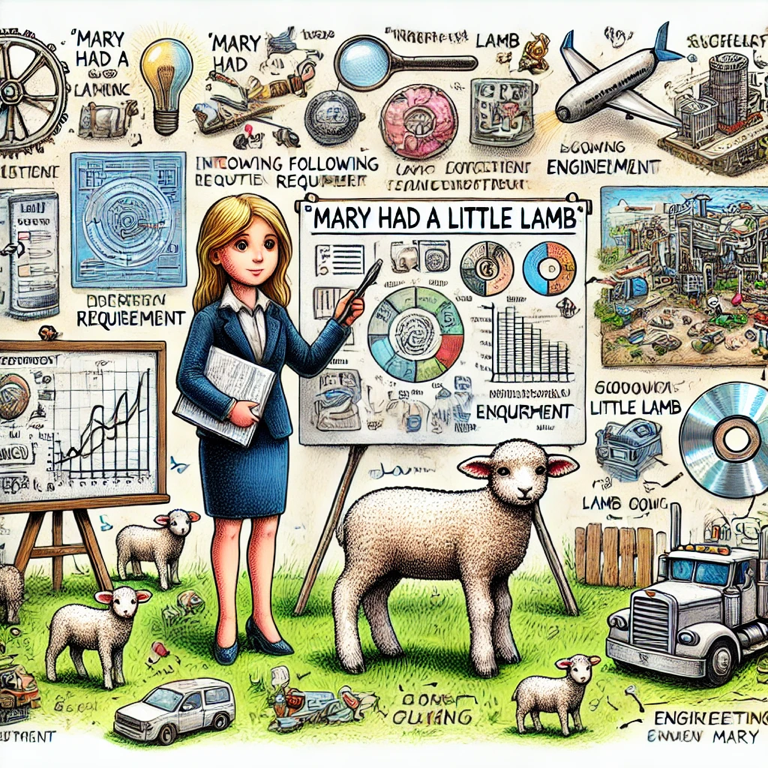
Mary breaks down the requirements of her lamb to her business audience.

In the world of engineering, clarity is king. No matter what you’re working on, the way you communicate requirements can make or break the success of the entire effort. 

A great example that I often refer to is “Mary Had a Little Lamb.” It’s a simple example, hearkening back to childhood, but it’s powerful in illustrating how easily things can go awry with vague or ambiguous requirements.

How do you interpret “Mary Had a Little Lamb”?

At first glance, this statement seems straightforward, but let’s break it down. Depending on who’s reading it, this simple sentence could be interpreted in several very different ways:

  • Mary owned a small lamb: Most people might initially assume that this means Mary had possession of a lamb that was small in size.
  • Mary consumed a lamb: Did Mary eat lamb for dinner?
  • The lamb was small only at a specific time: Maybe the lamb was little only during the time Mary had it, but it grew later.
  • Mary was followed by a lamb: If we’re being poetic, perhaps the lamb followed Mary around and not just to school one day. (Pro tip: Don’t be poetic when writing requirements.)
  • Mary gave birth to a lamb: In some contexts, “had” could imply that Mary gave birth to the lamb, which introduces a whole different scenario.

The Engineering Context

When you’re writing engineering requirements, this kind of ambiguity is the last thing you want. Imagine if each member of your team interpreted a requirement differently—one builds a system to own a lamb, another builds one to eat it, and a third builds it to follow someone around. The result? Chaos, rework, and a lot of wasted time and resources.

“Mary Had a Little Lamb” underscores the importance of being specific, detailed, and clear in your requirements. In engineering, there is no room for assumptions or vague language. What might seem obvious to you could be interpreted in entirely different ways by others.

Avoiding Ambiguity in Requirements

To avoid the pitfalls that our friend Mary encountered, here are a few strategies for writing clear engineering requirements:

  • Use precise language: Words like “little,” “some,” or “often” can be open to interpretation. Be specific with quantities, sizes, and timelines.
  • Avoid ambiguous terms: Replace words that can have multiple meanings with more explicit terms. Instead of saying “She had a lamb,” say “Mary owns a lamb that weighs 20 pounds (with +/- 2 oz. tolerance if that’s acceptable, of course).”
  • Clarify assumptions: Don’t assume everyone has the same background knowledge. Spell out any assumptions that could affect understanding. Using the Terms feature in DOORS Next to create a dictionary for your project is a great way to avoid problems down the line.
  • Provide context: If a requirement cannot be understood by itself, ensure it’s completely understood when viewed as part of a traceability matrix. Requirements Management tools like DOORS and DOORS Next can really help ensure that the related context up and down the Systems Engineering V is always visible to users. 
  • Can you test it?: What would the steps for testing whether Mary did indeed have a little lamb be? Writing a proposed test and working backwards from the test steps could not only help your requirements be written better, but considering testing from the start could affect the entire design of your system. Plus, your testers will thank you for involving them early and often, leading to a more cohesive team.

The Takeaway

“Mary Had a Little Lamb” is a simple reminder that in engineering, the devil truly is in the details. When requirements are clear and unambiguous, teams can align more easily, work more efficiently, and ultimately, deliver better results. So, the next time you’re drafting a requirement, remember Mary and her lamb—and make sure there’s no room for misinterpretation.

Clear communication is the foundation of success, whether you’re managing a small project or complex system. Let’s ensure our engineering requirements are as precise as our engineering itself.

IBM Engineering Lifecycle Management 7.0.3 Released!

  • by

It’s not just an area code in the US state of Northern Virginia, it’s also the latest release of IBM Engineering Lifecycle Management (ELM) which includes Jazz Team Server (JTS), Engineering Requirements Management DOORS Next (ERM/DNG), Engineering Test Management (ETM), Engineering Workflow Management (EWM), as well as other related tools like Reporting PUB (RPE) and Global Configuration Management (GCM). Not to sleep on Rhapsody Model Manager as well.

Version 7.0.2 was originally released nearly 3 years ago. Crazy how time flies. This release has been a long, long time coming and we can’t wait to get our hands on it now that it’s officially GAd. Sure, you can visit the new and noteworthy items on Jazz.net to see more details but we’re always interested in changes that haven’t been officially advertised, including an DNG Reportable Rest API enhancement we’ve been waiting years for.

We will eventually cover the best of what’s new. As always, we don’t recommend upgrading your production instance right away. Instead, wait for the first or second iFix and then do your upgrade. Make a backup first, or even better, clone your environment and use a hosts file in the cloned environment to redirect DNS hostnames and test out the upgrade there.

Also, there are quite a few deprecated items. To me, the big one is you must move from WebSphere Application Server (WAS) to WebSphere Liberty. Honestly this is really a great thing even if you’re used to WAS. Liberty is much easier to work with overall.

We have some amazing things coming down the pipe and are very excited about this new release.

In the meantime don’t hesitate to contact us if we can help your organization with DOORS, DOORS Next, ELM, or any other related items, including licensing, DOORS 9 to DOORS Next migrations, and Engineering Lifecycle Management customizations including reporting templates in RPE PUB and widgets and extensions.

A Fresh Face And New Beginnings

  • by

Hi all. It’s been a while. With things getting back to normal in the business world post COVID, I’ve taken time to reflect and direct where I want this company to go.

In that regard I’ve hired a few people recently and one thing everyone keeps saying is “updated your Web site.” And they’re right. Since starting Baselines Incorporated, I’ve been customer focused. Hyper customer focused. And I, myself, will always be. We exist to make our clients happy. Period. We do not fail in that regard and have never failed.

That means the Web site suffers. And that’s not how you grow a business.

Not a real one that can endure, anyway.

Watch this space. We are serious about growing, partnering with IBM and end clients to help get as much value out of the IBM Engineering Lifecycle Management suite of tools as possible. There will be articles, videos, and events.

It’s fitting, as IBM ELM 7.0.2 SR1 is also a new beginning too. The 7.0 release has been a little bumpy as the backend architecture of the tools has been altered, especially in Engineering Requirements DOORS Next, where performance has massively improved. Today, the 6.x versions of the tool are no longer supported. Bottom line: if you’ve not upgraded, it’s time. And we can help.

As the 7.0 tools got a new coat of paint, so does this site. There’s an improved landing page that will be further improved in the near future.

The value this site has provided isn’t going anywhere. The DXL Repository and The DSX Files will continue to be available. And we’ll continue to provide more and more value as time progresses.

Thank you for supporting us for 15 years. Great things are coming.

DOORS Next 7.0 is GA!

  • by

It’s taken a while, but today the wait is over. IBM Engineering Requirements Management DOORS Next 7.0 has been officially released!

As always, IBM has an overview of what’s new and noteworthy. But here are things we’d like to highlight as being significant.

Greatly improved performance

I hear that in some use cases, performance of the tool has gone up anywhere from 4x to 9x! Rumor is that Oracle DBs have shown the most improvements. This is reason alone to upgrade.

DNG has been renamed

It was not only DOORS Next Generation, but every tool has now been renamed. This was announced about a year ago by IBM. I’m still getting used to it, as are our clients. DOORS Next got the easiest adjustment.

Suspect Links Have Been Replaced With Link Validity

It’s no secret that IBM developers sometimes overcomplicate things. Suspect Links vs. Link Validity is one of those things. It took me a while to wrap my head around the concept.

Starting in 7.0, there is only Link Validity. I think this is a good thing overall and look forward to simplifying the explanation of things to my users.

This also corresponds to Link Validity being reportable in JRS! I worked really closely with IBM support to develop a report for one of my clients in 6.0.5, and it’s great to know that pain is now gone.

View columns are preserved when you switch to folders

In previous versions of the tool, you’d be in your folders view, and insert a few columns. Then you’d click a new folder, and you’d lose your columns. I worked with the DOORS Next developers on this and gave them feedback on how it should work. My feedback has been incorporated into the tool.

Yellow row highlight for new and copied artifacts cleared automatically

My users asked for this years ago, and now they have received.

Module and Collections pages no longer show the base artifacts folder

Chalk up another implementation that I’ve been asking for, for years. This is huge from a usability perspective.

Automatic type mapping for ReqIF imports

If you are involved in multiple imports/exports from ReqIF files, this should make things much smoother and less error prone.

Improved pages for empty collections and modules

Yet another one I’ll take some credit for — I’ve given DOORS Next developers feedback that it was not obvious to users how to paste an artifact into an empty module. It is now obvious.

Kevin Murphy

Chat with us!

Work with an IBM Champion to master your ELM tools.

Get in touch